









What does ceremonial cacao contain?
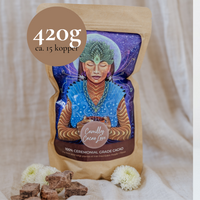
Camilles Cacao Love is made from a single ingredient: pure, unprocessed cacao bean mass.
And although it may sound simple, ceremonial cacao possesses a complexity and depth that has fascinated people for thousands of years.
When I share cacao with others, I do so with the wish that you can both experience its essence and understand what it is. Not only spiritually, but also in very concrete terms—as the plant and food that it is.
That is why I have had independent laboratory tests carried out on my Camilles Cacao Love—and the results tell a clear story about what is actually in this cacao.
Nutrition in its most natural form
My Camilles Cacao Love consists of 100% cacao bean mass from criollo cacao beans.
The laboratory analysis shows the following content per 100 g:
-
Energy: 656 kcal
-
Fat: 55.64 g
-
of which saturates: 36.15 g
-
-
Carbohydrate: 25.24 g
-
of which sugars: 0.2 g
-
-
Fibre: 15.4 g
-
Protein: 13.67 g
-
Salt: 0 g
This also means that a 28 g cup of cacao contains approximately:
-
184 kcal
-
15.6 g fat
-
7.1 g carbohydrate
-
4.3 g fibre
-
3.8 g protein
-
0 g salt
For when we talk about cacao, we are not just talking about a flavouring. The cacao bean naturally contains fat, protein, fibre, minerals and various plant compounds—and in my cacao, they all come from this one single raw ingredient.
The fat in cacao
A large part of cacao's natural composition consists of fat from the cacao bean.
In my laboratory analysis, fat accounts for 55.64 g per 100 g of cacao.
This is also one of the reasons ceremonial cacao has that smooth, almost creamy mouthfeel when prepared as a hot drink. Instead of being a defatted powder, as is the case with many cacao powders, the cacao bean's natural fat is still part of the cacao mass.
Protein and fibre
Cacao also naturally contains protein and fibre.
My analysis shows 13.67 g of protein and 15.4 g of fibre per 100 g.
In a 28 g cup, this corresponds to approximately 3.8 g of protein and 4.3 g of fibre.
So it is not just fat that makes up the cacao bean. It contains a whole range of different nutrients from the bean itself.
Minerals
In addition to fat, protein and fibre, cacao naturally contains various minerals and trace elements.
My laboratory analysis shows, among others, magnesium, iron, potassium, copper and zinc.
It is important for me to distinguish between two things here:
I can tell you what cacao contains.
I can also tell you how much of a particular nutrient the laboratory analysis shows.
But I will not use this knowledge to tell you what cacao does for your body.
That is an important distinction.
What am I actually allowed to tell you?
There is a difference between a nutritional statement and a health claim.
I am allowed to tell you that my cacao contains, for example, magnesium, iron, potassium, copper and zinc, when the information is documented.
However, I must be far more cautious when I start talking about what these nutrients do for the body—and especially when I link cacao to specific physiological or health effects.
That is why I stick to what I can actually document:
What cacao contains.
And not what it does for you.
If you are curious about the functions of individual nutrients in the body, you can find more information from official health authorities or in the scientific sources behind the nutrients.
Theobromine and caffeine
The cacao bean also naturally contains methylxanthines, including theobromine and caffeine.
Theobromine is the methylxanthine found in much larger quantities in cacao than caffeine.
In my laboratory analysis, the theobromine content was measured at approximately 293 mg per 28 g of cacao, while caffeine was approximately 37 mg per 28 g.
This means that cacao naturally contains caffeine—but also that theobromine makes up a much larger proportion of these two substances in the amount of cacao I had analysed.
This is also one of the reasons why cacao cannot simply be compared directly with coffee. They are two different raw ingredients with different compositions.
Polyphenols—a part of cacao's natural plant compounds
Cacao also contains polyphenols, which are a group of naturally occurring plant compounds.
In my analysis, the polyphenol content was calculated at around 1,300 mg per 28 g of cacao.
When talking about polyphenols in cacao, however, it is worth remembering that the content can vary significantly depending on, among other things, the cacao variety, origin, fermentation, drying and processing.
That is why this is not a figure I would use as a universal figure for all cacao.
It is a figure from the cacao I had analysed.
But what does cacao actually look like compared to other foods?
This is a question I often find myself curious about.
For what does 98 mg of magnesium in a cup of cacao actually mean if you have nothing to compare it with?
That is why it can be interesting to place some of the figures alongside other common foods.
However, you must remember that the comparison depends on both portion size and the specific raw ingredient. A handful of pumpkin seeds is not the same as a cup of cacao, and raw spinach is not the same as cooked spinach.
When I make such comparisons, I therefore use concrete nutritional databases and state the source, so you can go back and see the figures yourself.
A plant with a very long history
And then, of course, there is everything that cannot be measured in a laboratory.
Cacao has a history that goes back a long way.
The cacao tree originated in the Amazon region, and cacao has been part of various indigenous cultures in Mesoamerica and South America for thousands of years.
In Mesoamerica, cacao was used as food, a drink, a commodity, and in ceremonial and social contexts. Cacao also appears in the mythological stories preserved from the Mayan world.
In the Popol Vuh, the sacred narrative of the K'iche' Maya, cacao is part of the larger cosmological narrative about humanity, the earth, and the relationship between people and the divine.
This is one of the things I love about cacao.
For although today we can send a sample to a laboratory and have the grams of fat, protein, fibre, minerals and various plant compounds calculated, the figures only tell one part of the story.
There is also a cultural story.
A botanical story.
A story of people, land, trade, rituals and relationships.
And then there is the completely personal story that arises when you make your own cup, sit down, and give yourself a moment free from distractions.
Sources and method
The nutritional values for Camilles Cacao Love are based on independent laboratory analyses of the cacao analysed, carried out by Eurofins—paid for by Camilles Cacao Love, based on the 2024 batch.
Nutritional values for comparable foods are sourced from Food Data (FRIDA), DTU Food Institute. The values are indicative and may vary depending on the raw ingredient, variety, origin, growing conditions, processing and portion size.
Information about specific plant compounds and cacao's history should be read with reference to the specific scientific and historical sources indicated with the individual pieces of information.

Written by Camille Ingvild


Leave a comment
This site is protected by hCaptcha and the hCaptcha Privacy Policy and Terms of Service apply.