


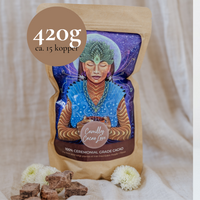







Nutrition in one cup of cocoa 🤎 (28g)
Sources:
Nutritional values for comparable foods are sourced from Fødevaredata (FRIDA), DTU Food Institute. Information on specific plant compounds is sourced from the scientific sources cited with the individual pieces of information. Values may vary depending on the raw material, variety, origin, processing, and portion size.
Laboratory testing of the cacao was conducted as an independent analysis by Eurofins, self-funded by Camilles Cacao Love, and performed on the 2024 batch.
Nutrition in one cup of cacao 🤎 (28g) - When nutrition, connection, and awareness meet
When you sit with your cup of Camilles Cacao Love, I want you to be able to intentionally take in the nutrition.
Not only emotionally and in your inner work, but also to know very concretely what it is you are drinking.
Ceremonial cacao is, for many, a plant you connect with. A moment where the pace slows down, and the body is allowed to land.
But cacao is also an exceptionally nutrient-dense food.
And therefore, I think it is interesting to look very concretely at what one cup of approximately 28 g contains.
Here I share what my laboratory tests show and put it into perspective.
Magnesium – a mineral in cacao
Approx. 98 mg per cup of cacao (28 g)
Magnesium is a mineral that occurs naturally in cacao and is involved in many of the body's normal functions.
Magnesium contributes, among other things, to the normal function of the nervous system, normal muscle function, normal energy metabolism, and to the reduction of tiredness and fatigue.
Facts in perspective:
– 98 mg of magnesium is approximately equivalent to the content in 30–40 g of pumpkin seeds
– A standard multivitamin (e.g., Nani) contains approx. 50 mg
– OmniMin (a vitamin pill on the Danish market from Biosym) typically contains 50–100 mg depending on the dose
– Coffee contains only small traces
– Matcha contains approx. 5–10 mg per cup
Potassium – a natural mineral in cacao
Approx. 308 mg per cup of cacao
Potassium occurs naturally in cacao and is one of the minerals the laboratory finds in my cacao.
Potassium contributes, among other things, to the normal function of the nervous system, normal muscle function, and the maintenance of normal blood pressure.
Facts in perspective:
– 308 mg of potassium is approximately equivalent to one large banana
– Most multivitamins contain very little or no potassium
– Coffee contains approx. 100 mg per cup
– Matcha and green tea contain only small amounts
Iron – a natural mineral in cacao
Approx. 2.2 mg per cup of cacao
Iron is a mineral that occurs naturally in cacao.
Iron contributes, among other things, to normal oxygen transport in the body, normal energy metabolism, normal cognitive function, and the normal function of the immune system.
Cacao contributes plant-based iron as part of the overall composition of the cacao bean.
Facts in perspective:
– 2.2 mg of iron is approximately equivalent to 100 g of spinach
– Nani multivitamin: approx. 2.4 mg
– OmniMin: approx. 5–10 mg depending on the dose
– Coffee and matcha contain very little iron
Zinc – a mineral in cacao
Approx. 1.3 mg per cup of cacao
Zinc also occurs naturally in the cacao bean.
Zinc contributes, among other things, to the normal function of the immune system, normal cognitive function, and the maintenance of normal skin, hair, and nails.
Facts in perspective:
– 1.3 mg is approximately equivalent to a small handful of nuts
– Nani: approx. 4 mg
– OmniMin: approx. 6–12 mg
– Coffee and matcha contain only traces
Copper – another natural mineral
Approx. 0.6 mg per cup of cacao
Copper occurs naturally in cacao and contributes, among other things, to normal iron transport, normal energy metabolism, the normal function of the nervous system, and the maintenance of normal connective tissue.
Facts in perspective:
– 0.6 mg is a significant amount from a single food
– Nani: approx. 0.4 mg
– OmniMin: approx. 0.25–0.5 mg
– Coffee and matcha contain only minimal amounts
Polyphenols – part of cacao's natural composition
Approx. 1,300 mg per cup of cacao
Approx. 4,600–5,600 mg per 100 g
Polyphenols are naturally occurring plant compounds found in many plants and foods.
They are part of cacao's natural composition and are among the compounds that help give cacao its characteristic taste, bitterness, and complexity.
Here I think it is interesting to look at cacao as a plant rather than making each individual compound an explanation for what you should feel when you drink it.
Facts in perspective:
– 1,300 mg of polyphenols is approximately equivalent to:
• 250–300 g of blueberries
• 2–3 cups of strong coffee
• 5–7 cups of green tea
• 6–8 g of ceremonial matcha
Matcha is very rich per gram – but the portion size is significantly smaller than cacao.
Fiber – part of the cacao bean's structure
Approx. 4.3 g of dietary fiber per cup of cacao
The cacao bean naturally contains dietary fiber, and my laboratory tests show 15.4 g of dietary fiber per 100 g of cacao.
Facts in perspective:
– 4.3 g of fiber is equivalent to a small portion of oatmeal
– Coffee and tea contain 0 g
– Matcha contains only very small amounts
Protein – plant protein in your cup
Approx. 3.8 g of plant protein per cup of cacao
Protein is a natural part of the cacao bean's composition, and my laboratory tests show 13.67 g of protein per 100 g.
Facts in perspective:
– More than in coffee, tea, and matcha
– Not as high as legumes – but a natural part of the whole
Caffeine & theobromine
Cacao contains both caffeine and theobromine, and both occur naturally in the cacao bean.
Theobromine is one of the compounds that is particularly characteristic of cacao, and together with, among other things, the cacao bean's other natural plant compounds, it is part of what makes cacao cacao.
In my laboratory analysis, the content is approx. 293 mg of theobromine and approx. 37 mg of caffeine per cup of 28 g cacao.
Comparison:
– Coffee: approx. 80–120 mg of caffeine per cup
– Ceremonial matcha: approx. 60–70 mg of caffeine per cup
– Cacao: approx. 37 mg of caffeine per cup
A concluding thought
Ceremonial cacao is not just something you drink - it is a plant you can enter into a relationship with.
And at the same time, it is a food that contains minerals, fiber, fat, protein, and natural plant compounds.
For me, the spiritual relationship has always been what has carried me through the years. But bringing awareness to the physical nutrition gives me greater joy when I sit and enjoy my cacao. Knowing that I am taking this in and nourishing myself.
And I hope that this post with this knowledge you have now received nourishes you to the same extent 🤎
Sources:
Nutritional values for comparable foods are sourced from Fødevaredata (FRIDA), DTU Food Institute. Information on specific plant compounds is sourced from the scientific sources cited with the individual pieces of information. Values may vary depending on the raw material, variety, origin, processing, and portion size.
Laboratory testing of the cacao was conducted as an independent analysis by Eurofins, self-funded by Camilles Cacao Love, and performed on the 2024 batch.

Written by Camille Ingvild


Leave a comment
This site is protected by hCaptcha and the hCaptcha Privacy Policy and Terms of Service apply.